The Diamond Triangle: A Day Among Odisha’s Forgotten Buddhist Monasteries
You start with a name that sounds like a mistake.
Someone tells you about a place called the Diamond Triangle. You picture a hotel, or a jewellery market, or at best a tourist circuit with a gift shop. Then you look it up and find three ancient Buddhist sites in the Odisha countryside, each one a ruined monastery, with a crowd of almost nobody.
You pack water and a hat, and you go.
The road out
You leave Bhubaneswar early and head north. The highway runs flat and fast, then loosens into smaller roads lined with paddy, banana trees and the occasional shrine painted bright orange. Little villages appear and vanish. A boy on a bicycle races your car for about a hundred metres and wins.
The three sites are in Jajpur district, a few hours from the city, and they sit close together on low hills among the fields. They are Ratnagiri, Udayagiri and Lalitgiri. Don’t confuse this Udayagiri with the cave site near Bhubaneswar. Same name, different place, different faith, different century.
Nobody ever warns you how quiet the countryside is until you stand in it.
Lalitgiri: the first surprise
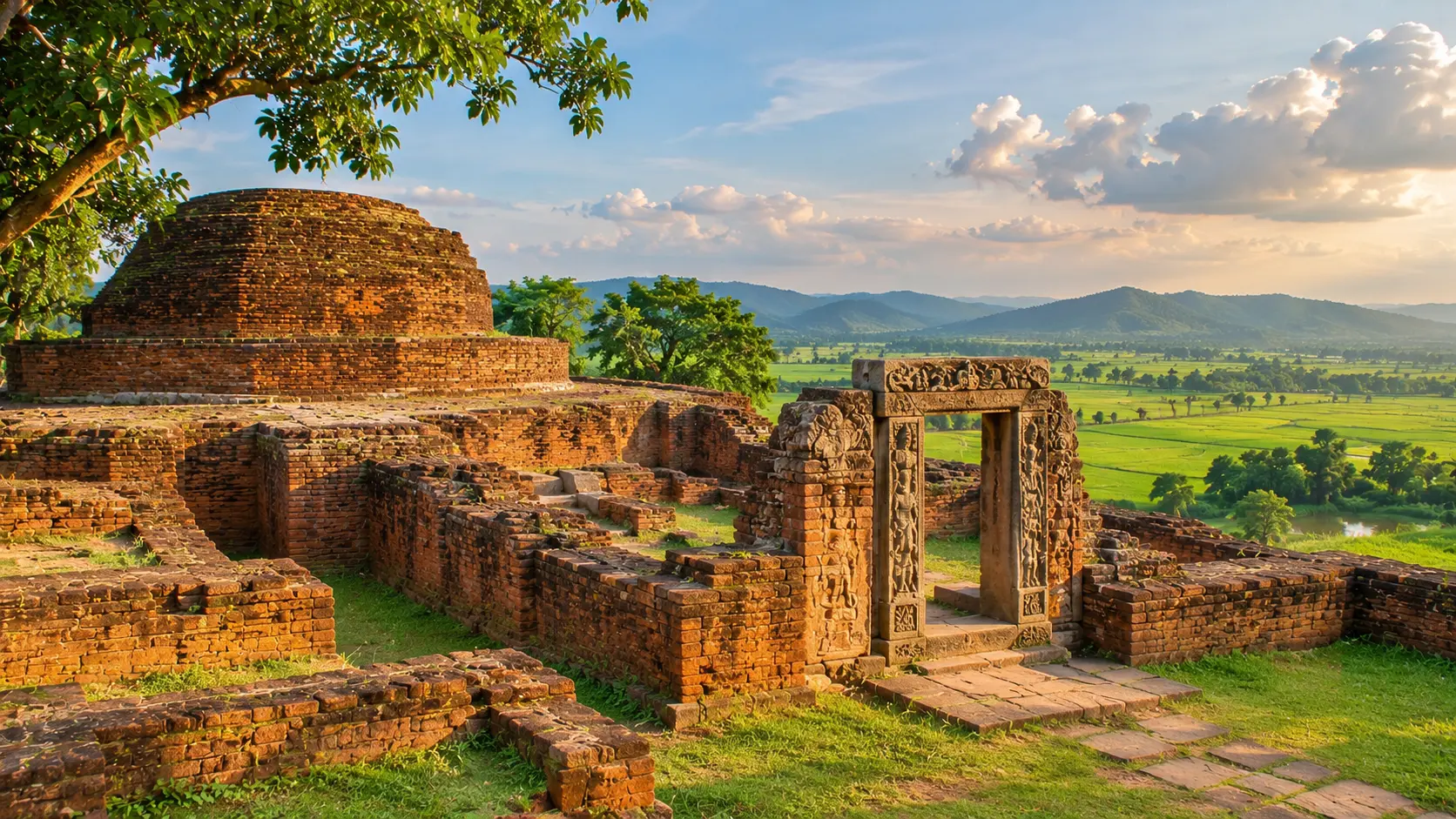
You reach Lalitgiri first. A path climbs up through the trees and then opens onto a broad hilltop, and there it is, a large round stupa made of old bricks, weathered to the colour of dry clay. It looks smaller and plainer than you imagined and it holds your attention for longer than you’d have guessed.
Around it, the ruins of monastery buildings spread across the hill: low walls, courtyards, stairways that end in air. A caretaker sits in the shade, not bothering to stand when you pass. He nods and goes back to his tea.
You walk slowly. You touch a wall. It’s warm from the sun, and the bricks are rough under your hand. Somewhere nearby, a bird calls the same two notes over and over, as if someone taught it to.
There’s a small museum at the base of the hill, holding statues and carved pieces found in the digs. Heads of the Buddha, serene and half-smiling, sit on shelves behind glass. A few of them have lost their noses to time. None of them look bothered.
Ratnagiri: where it all comes together
By midday you’re at Ratnagiri, and this is the one you’ll talk about afterwards.
The site sits on a hill above a bend in the river, and it feels like a small town that someone paused. A big monastery stands at the centre, with a courtyard, rows of monks’ cells, a carved stone doorway and a long drain still running through the floor. You can picture it full of people: robes, voices, the slow smell of lamp oil.
The doorway stops you. It’s heavy with carving, flowers and figures and scrolling patterns, every inch worked by someone with enormous patience. You stand there longer than you planned. It’s the kind of detail the temples in the city rarely let you get close to.
Around the monastery, smaller stupas and shrines sit scattered among the grass, and statues of the Buddha and other figures rest in the shade, some whole, some broken. The place feels crowded with presence and empty of people, and you realise those two things are connected.
Lunch under a tree
You eat on a low wall, in the shade of an old tree. Rice, dal and a vegetable curry from a roadside stall, wrapped in a banana leaf and eaten with your fingers. A dog arrives, lies down near your feet and makes no demands.
A guide who has walked here a thousand times points to a hill in the distance. “Udayagiri,” he says. “Tomorrow, or after lunch, if you are strong.”
You are not strong, but you go anyway.
Udayagiri: the last climb
Udayagiri is the biggest of the three, and it takes the longest to walk. Paths wind through forest and open into clearings with stupas, monastery walls and statues in niches. A huge seated Buddha rests against one wall, calm and unmoved by the rain, the sun or the centuries.
By now the afternoon light has turned amber. Long shadows lie across the courtyards, and the bricks glow, and everything looks like a painting that hasn’t dried yet. A couple of other visitors wander in the distance, small as figures in a landscape. Nobody speaks above a murmur.
You sit on a low step and watch the light move across the stone. You haven’t checked your phone for hours. It doesn’t seem like a loss.
What stays with you
It’s the scale of what has been forgotten. These monasteries once drew scholars and monks from far away, and then the people left, and the forest and the fields closed over them. For a long time they lay under grass and earth, hidden in plain sight, until diggers and archaeologists lifted the soil off them.
Now they sit in sunlight, half explained, half mysterious, and almost nobody comes.
You leave late. The sun drops behind the hills and the sky turns the colour of a ripe mango. On the way back, the driver stops at a tea stall without being asked. You drink a glass of strong, sweet tea in the dusk with the radio playing somewhere behind you and the highway lights coming on one by one.
You think: this was a Wednesday. Nobody knew we were here.
If you want to go
1. Plan a full day. The three sites are close together but spread across hills, so start early and give each one time.
2. Check everything first. Opening days, museum timings, entry fees and access change, so confirm with the Archaeological Survey of India or the Odisha tourism office before you travel.
3. Carry water, a hat and sunscreen. There is little shade at the hilltops.
4. Wear sturdy shoes. Paths are uneven, and some stairways are worn.
5. Hire a local guide if you can. The stories behind the ruins make them far more vivid.
6. Treat the sites with respect. Don’t climb on old walls, take anything or leave rubbish.
This is a travel narrative, written to capture the feel of the day. Details of the people and the hour-by-hour route are illustrative, so check current facts locally before you plan.
The Plorastay team writes from Patrapada, Bhubaneswar, where our guest house offers AC rooms, kitchens in selected rooms, free parking and airport pickup for travellers planning trips like this.