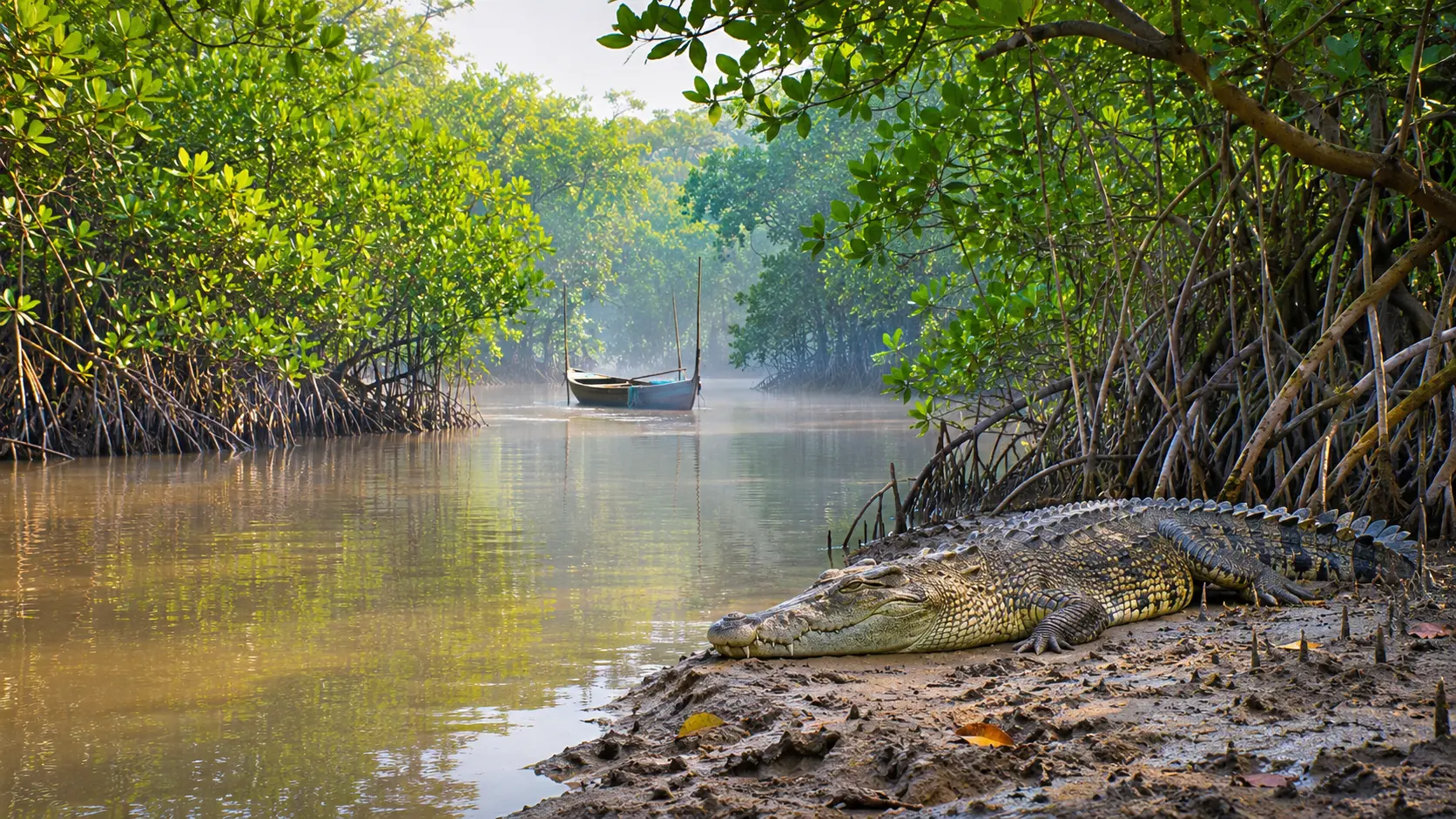
Into the Mangroves: A Boat Day at Bhitarkanika, Where the Crocodiles Own the River
You leave before the city has finished waking up.
Bhubaneswar slips behind you in the usual order: the temple spires, then the flyovers, then the first long stretch of paddy fields with mist sitting low on them like milk in a bowl. The driver puts on a radio station that’s mostly static and an old Odia song. You don’t ask him to change it.
The road to Bhitarkanika is long. It takes most of a morning, and somewhere in the middle you stop caring about how long. The land gets flatter and wetter. Ponds appear, then canals, then fields that are more water than field. Palm trees lean in odd directions. A man on a cycle carries a tower of dried fish, steering with one finger.
By the time you reach the last village, the air has changed. It smells of salt and mud and something green and wet. The driver rolls down his window, breathes in, and says, “Paani aa gaya.” The water has arrived.
The edge of the land
Bhitarkanika sits where the Brahmani and Baitarani rivers fold into the Bay of Bengal. It’s a delta, which means the map there is really a suggestion. Rivers split into channels, channels split into creeks, and the creeks wander through one of the largest mangrove forests in India. At high tide the forest floor disappears. At low tide it reappears, covered in a thousand thin roots like bent fingers.
Before you can go in, you do the dull part. Permits, entry fees, forms, a forest office with a ceiling fan that’s working harder than it should. A guard writes your name in a ledger, slowly, in careful Odia. You’d read the rules in advance: stay in the boat, keep your voice down, no feeding, no leaning over the side. Out here the rules aren’t suggestions. The animals in this water are very good at their job.
The boat
It’s a long, flat, wooden boat with a small engine and a canopy that doesn’t cover much. A boatman and a forest guide sit up front, the guide holding a pair of binoculars with tape around one lens.
The engine starts. The jetty slides away. And then the noise of the village drops out, all at once, like someone closing a door.
The creek is narrow. Mangrove roots crowd the bank on both sides, dark and tangled, and the trees lean over so their leaves almost touch above you. The light turns green. You can hear the water slapping softly against the hull, and the whine of the engine, and underneath it the rustle of a thousand small things moving in the mud.
You see them before you understand what they are. Little brown creatures, flipping and skittering across the exposed mud. Mudskippers, the guide says, fish that decided water was optional. One of them stares at you with bulging eyes, and you could swear it’s unimpressed.
The first one
The guide raises one hand without turning around. The boatman cuts the engine.
Silence. The boat drifts.
On the bank, maybe thirty metres ahead, there’s a shape you took for a fallen branch. Then the branch yawns.
A saltwater crocodile. A big one. It lies half in the sun, half in the shade, the colour of old wet stone, with a jaw that opens slowly and shows you a row of teeth. It looks like something drawn from an older version of the world. It watches you the way a landlord watches a late tenant.
Nobody speaks. You realise you’re holding the edge of the seat. You let go, carefully, one finger at a time.
“That one is about fifteen feet,” the guide says, very quietly. You can’t tell if he’s measuring or guessing. It doesn’t matter. The boat feels very small.
Then it slides off the bank, and the water closes over it without a ripple, and the river is just a river again.
The river isn’t just a river. You know that now.
The slow hours
The middle of the day is the quiet stretch. The tide shifts and the creek widens. The guide points out a monitor lizard on a branch, its tongue flicking, its body the length of your arm. A kingfisher dives and misses. A heron stands in the shallows pretending to be a statue and failing only when it blinks.
Overhead, a line of white birds crosses the sky in a loose, wavering V, heading somewhere important. The guide names them with a calm that makes you suspect he’s said it a thousand times and still means it.
Lunch is rice and fish curry from a steel tiffin, eaten in the boat with your fingers while the engine’s off. The fish tastes of the river it came from. Somebody laughs, somebody else shushes them, and you all stay very still for a long minute because a ripple appeared and no one is sure why.
By afternoon the heat has settled in, thick and heavy, and the water has turned the colour of strong tea. You trail your fingers along the air above it, not in it. You aren’t that foolish.
What you remember
It’s the small things. The way the boatman steers with his foot. The smell of mud and salt. A single orange flower on a mangrove branch, bright against all that green. The moment the guide taps your shoulder and points to a second pair of eyes, just above the waterline, that you would never have found alone.
You came for the crocodiles. You’ll remember the silence between them.
On the way back the sun drops low and everything turns the colour of copper. The creek is still. The roots look like they’re sleeping. You pass the same bend where you saw the first crocodile, and it’s empty, but the bank has a long smooth scrape in the mud where something heavy slid into the water.
You think about how many of those scrapes there are in the forest. How many pairs of eyes were watching the boat you didn’t see.
Then the jetty appears, and the village noise comes back all at once, and the spell breaks.
The drive home is long. You sleep for most of it. When you wake, the temple spires of Bhubaneswar are rising against the dark, and for a second you can’t remember which world you belong to.
If you want to go
1. Check the rules first. Entry permits, boat availability, timings and the best season change, so confirm with the Odisha forest department before you travel.
2. Start early. It’s a long drive, and the animals are most active in the morning.
3. Stay in the boat. Never lean out, never trail your hands, and follow your guide’s instructions every time.
4. Carry water, a hat, sunscreen and insect repellent. There’s little shade on the water.
5. Bring binoculars if you have them. They make the birds and distant crocodiles much easier to spot.
6. Take your rubbish home.
This is a travel narrative, written to capture the feel of a day on the water. Details of the boat, the guide and the people are illustrative, so check current facts locally before you plan.
The Plorastay team writes from Patrapada, Bhubaneswar, where our guest house offers AC rooms, kitchens in selected rooms, free parking and airport pickup for travellers planning trips like this.