Elephants at the Edge of the City: A Morning in Chandaka Forest
You don’t need a long drive for this one. That’s the surprise.
Most adventures begin with an alarm at 4 a.m. and a road that takes most of the day. This one begins twenty minutes from your breakfast table in Bhubaneswar, on the other side of a ring road, where the buildings simply give up and the forest takes over.
You almost miss the turn. The signboard is small, a little faded, and there’s a tea stall on the corner with a calendar from three years ago. Then the car slips between two rows of tall trees, the road narrows, and the noise of the city drops away like a coat being taken from your shoulders.
The forest next door
Chandaka is a big stretch of dry deciduous forest on the western edge of the city, part of a sanctuary that people here are quietly proud of. It isn’t a postcard jungle. The trees are tall but not thick, the light comes through in coins, and the ground is a mix of dry leaves and red earth. It looks like an ordinary forest until you start paying attention.
Then it stops looking ordinary.
You see the marks first. A trunk rubbed smooth at shoulder height. A branch snapped clean and left hanging. A patch of earth pressed flat and wide, as though a very heavy thing had sat down to think.
“Elephants,” says the guide. He says it softly, like a word you use at a library.
The rules of the morning
Before you go in, he gives you the talk. It takes two minutes and it’s the most useful two minutes of the day.
Stay together. Stay quiet. Stay behind him. If he stops, you stop. If he points, you look, but you don’t move toward it. No flash, no shouting, no running, ever. Elephants are calm until they aren’t, and the forest is their home, not a stage built for you.
You nod. You mean it.
Then you walk.
The slow part
The first hour is mostly quiet. You walk along a forest track, the guide ahead and the others behind, and the only sounds are footsteps, a rustle in the leaves and, somewhere far off, a bird making a noise like a rusty hinge.
You learn to look differently. Not for a big shape, but for what a big shape leaves behind. A pile of droppings, fresh and sweet-smelling. A stripped stretch of bark. A footprint pressed into a patch of soft ground, wide as a dinner plate, deep as your hand.
The guide kneels beside it and puts two fingers in the edge. “Last night,” he says. “Maybe early morning.”
You feel the hair rise on your arms. They were here. Not long ago. Probably close enough to hear you.
You walk on.
Smaller things
The forest rewards patience. A spotted deer steps out from behind a bush, freezes, stares at you with huge dark eyes and then vanishes without a sound. A peacock walks across the track ahead, unhurried, trailing its feathers, as if the whole forest were its private corridor. Langurs lounge in a tree, grooming each other with total concentration, ignoring you so completely it’s almost an insult.
A butterfly lands on your sleeve and stays there for a minute. You don’t move your arm. It leaves when it’s ready.
You realise you have stopped checking the time.
The waterhole
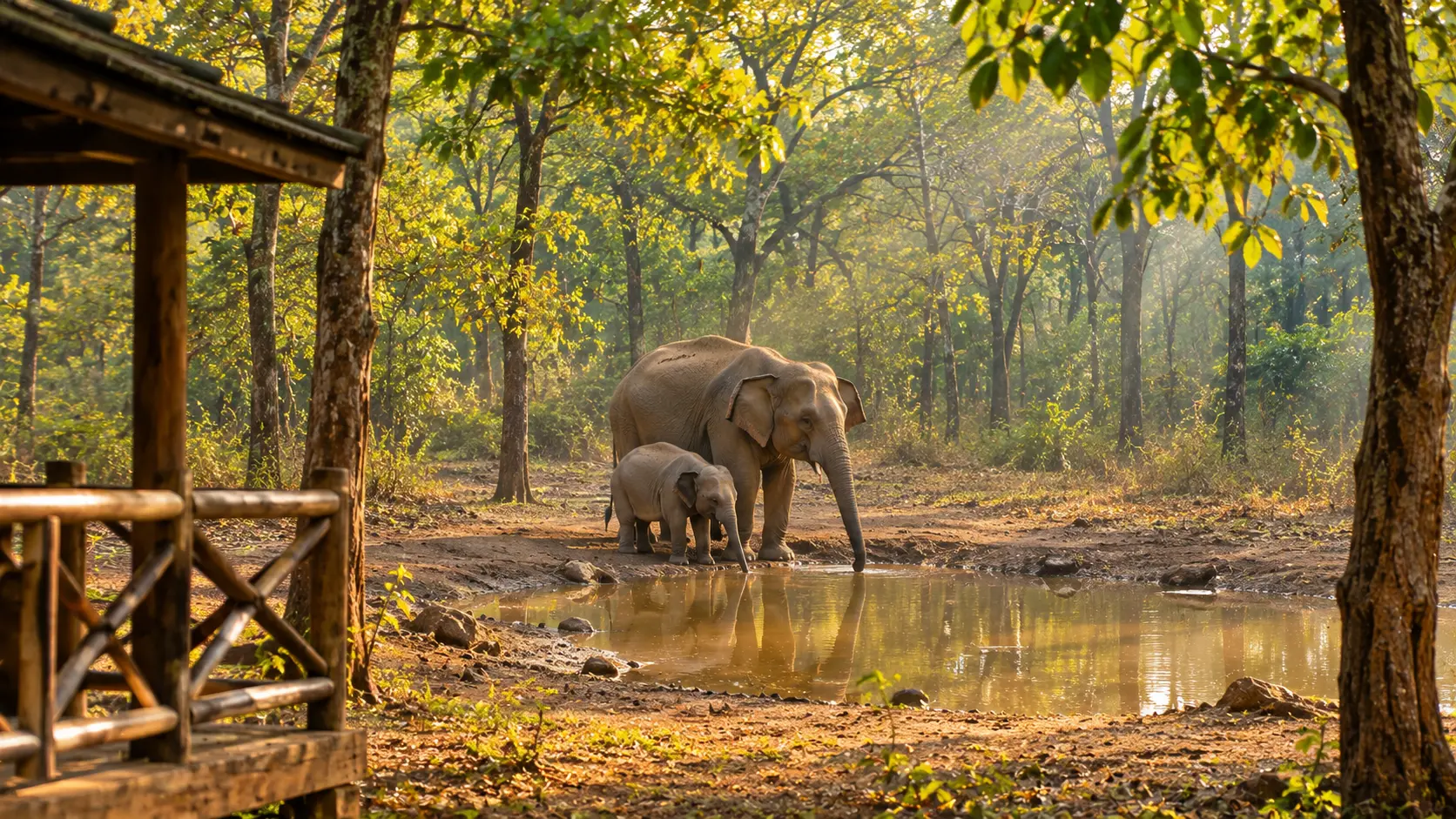
Around mid-morning the guide leads you to a small clearing with a muddy waterhole at the centre. A rough wooden platform stands at the edge. You climb up and sit down, slowly and carefully, and wait.
Nothing happens for a long while.
Then, out of the trees on the far side, something moves. A grey shape, enormous, slow and utterly unbothered. A trunk comes first, swinging, testing the air. Then a head, then the body, big as a small house, and yet it makes almost no sound as it walks.
An elephant.
You forget to breathe.
It stops at the edge of the water and lowers its trunk, and sucks up a huge amount in one pull, then swings it into its mouth. Behind it, a second figure appears, smaller, trailing close beside its mother’s leg. The calf watches you with small bright eyes and then loses interest and starts nosing at the mud.
Nobody on the platform speaks. Nobody even whispers. The mother lifts her head once, turns her great ears towards you, and holds that pose for a heartbeat long enough to make your pulse jump.
Then she lowers her head again and goes back to drinking.
You have been seen, and you have been allowed.
The walk back
You stay until the pair finish drinking and wander back into the trees, the calf bouncing along behind with its trunk looped over its mother’s tail. The clearing falls still again. A kingfisher lands where the elephants stood, bright blue on a brown bank, as if putting a full stop on the scene.
On the walk back the sun is higher and the forest has gone warm and gold. Your legs are tired. Your shirt is damp. Your head is quiet in a way it hasn’t been for weeks.
At the gate the guide shakes your hand and says, “You were good. Quiet.” It’s the best compliment you’ve had all year.
Back to the city
The ring road appears too quickly. Traffic, horns, an auto weaving past a truck, a hoarding for a mobile phone. It’s all exactly where you left it.
You sit at a red light and look at the buildings and think about how close the two worlds are. A twenty-minute drive. A thin line of trees. On one side, a city of millions. On the other, an elephant putting its trunk into a pool of muddy water, with no idea what time it is, and no reason to care.
The light turns green. You drive home slowly.
If you want to go
1. Check the rules first. Entry permits, guided walks, safari access and timings change, so confirm with the Odisha forest department before you travel.
2. Go early in the morning. Animals are most active at dawn, and the heat builds fast.
3. Always go with a guide. Never walk into the forest alone.
4. Dress in muted colours. Wear sturdy shoes, a hat and long sleeves for insects and thorns.
5. Stay quiet and keep your distance. Never approach an animal, never use flash and never feed wildlife.
6. Carry water and take your rubbish home.
This is a travel narrative, written to capture the feel of the morning. Details of the guide and the animals are illustrative, so check current facts locally before you plan, because sightings are never guaranteed.
The Plorastay team writes from Patrapada, Bhubaneswar, where our guest house offers AC rooms, kitchens in selected rooms, free parking and airport pickup for travellers planning trips like this.