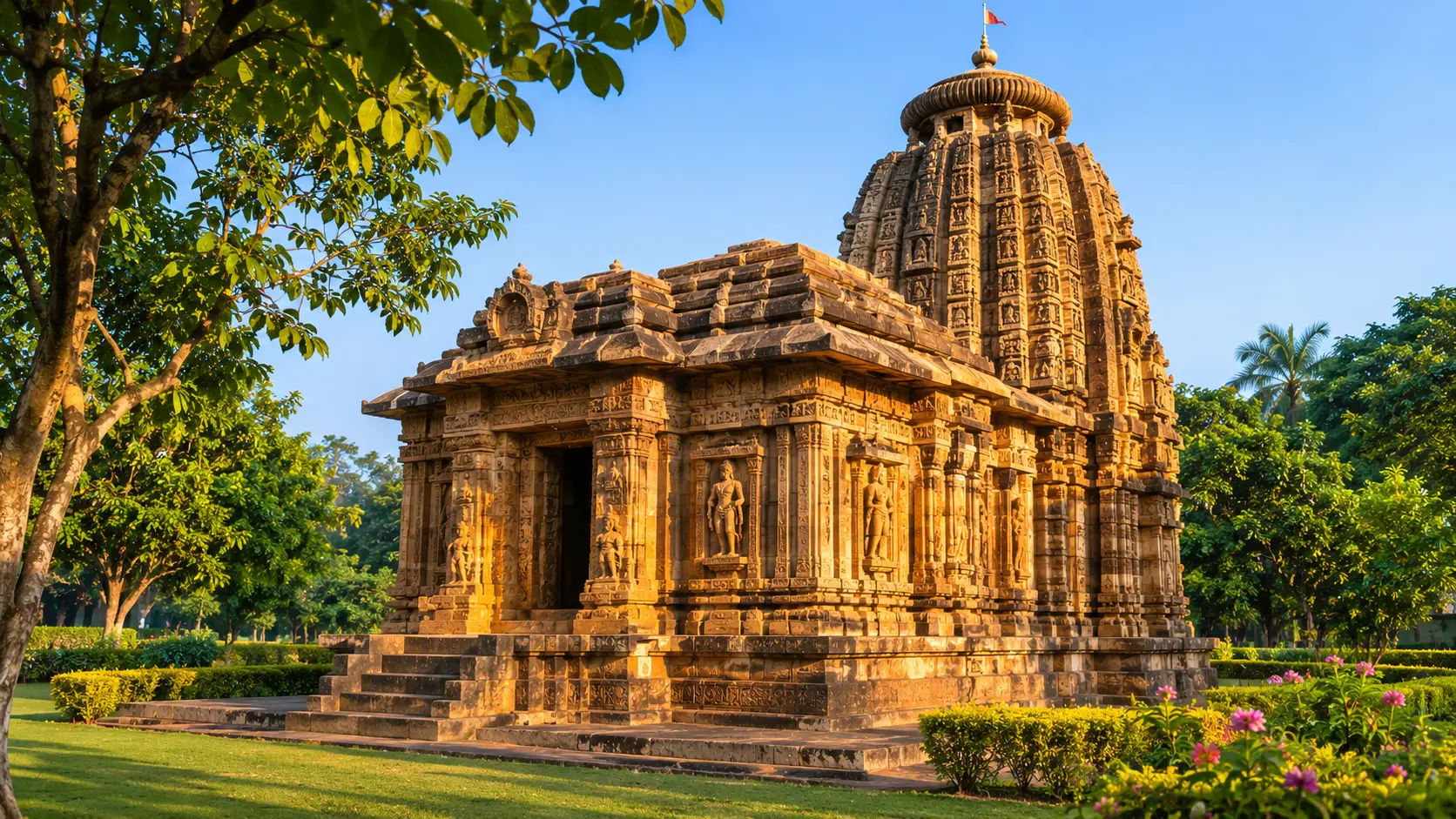
Bhubaneswar’s Lesser-Known Temples: Rajarani, Parsurameswar and Vaital Deul
Most visitors to Bhubaneswar go straight to Lingaraj and leave the city with one temple in their camera roll. Yet Bhubaneswar has hundreds of surviving temples from over a thousand years of building, and some of the best are small, quiet and rarely crowded. These three sit within a short auto ride of each other, so you can see all of them in a relaxed half day.
Why visit the smaller temples?
The big temples show you scale. The smaller ones show you detail. You can stand close to the carvings, take your time, and see the Kalinga style of architecture without a queue. They also make it easy to compare how temple design changed over the centuries, from the early, simple shrines to the grand later ones.
What is special about Rajarani Temple?
Rajarani is the odd one out, and that’s its charm. It was built in the 11th century from a golden-yellow sandstone, and unlike most temples in the city it has no deity inside. The spire is surrounded by clusters of smaller towers, and the outer walls are covered in delicate figures: graceful women, guardians of the directions and detailed floral patterns. It sits in a neat garden, which is why it’s also used for an annual classical music festival. Go in the late afternoon, when the low sun brings out the colour of the stone.
Why is Parsurameswar Temple worth seeing?
Parsurameswar is among the oldest temples in the city that is still standing, usually dated to around the 7th century. It’s small and low, but that’s the point. You can see an early version of the style that later grew into the tall spires of Lingaraj and Rajarani. Look at the carved stone windows with their lattice work, the friezes along the walls, and the way the figures are carved with a freedom that later temples became more formal about. It’s dedicated to Shiva and is a good first stop because it’s so easy to take in.
What makes Vaital Deul different?
Vaital Deul looks completely unlike the others. Instead of a tall spire, it has a curved, barrel-shaped roof, a style often compared to the roofs of southern gateways. It dates to around the 8th century and is dedicated to Chamunda, a fierce form of the goddess associated with the Tantric tradition. The inside is dark and quiet, and the carvings on the walls are some of the most striking in the city. Carry a small torch or your phone light to see the details inside. Of the three, this one feels the oldest and most atmospheric.
How do you plan the visit?
All three can be seen in half a day, in this order: Parsurameswar, Vaital Deul and then Rajarani, which is best saved for the golden light of the late afternoon. Hire an auto or an app cab for the half day and ask the driver to wait, since the lanes around the temples are narrow.
Some practical tips. Dress modestly, with shoulders and knees covered, and wear shoes that are easy to remove. Carry water and a hat, since there is little shade between stops. Check opening days and ticket rules before you go, because these change and some sites close on one day of the week. Hire a licensed guide at one of the sites if you want the stories behind the carvings, or read up on the Kalinga style beforehand.
How does this fit into a longer trip?
These temples work well alongside the main sights. Pair them with Lingaraj and Mukteshwar for a full temple day, or with the Udayagiri and Khandagiri caves for a day of old stone and rock-cut history. If you are planning two days in the city, our 2-day Bhubaneswar itinerary shows how to fit it all in at an easy pace, and our guide to getting around the city explains autos and cabs.
Where should you stay?
If you want a quiet base near AIIMS and the Khandagiri side of the city, Plorastay in Patrapada offers AC rooms, family suites, kitchens in selected rooms, free Wi-Fi, free parking and airport and railway station pickup. Reach us through the contact page to check availability.