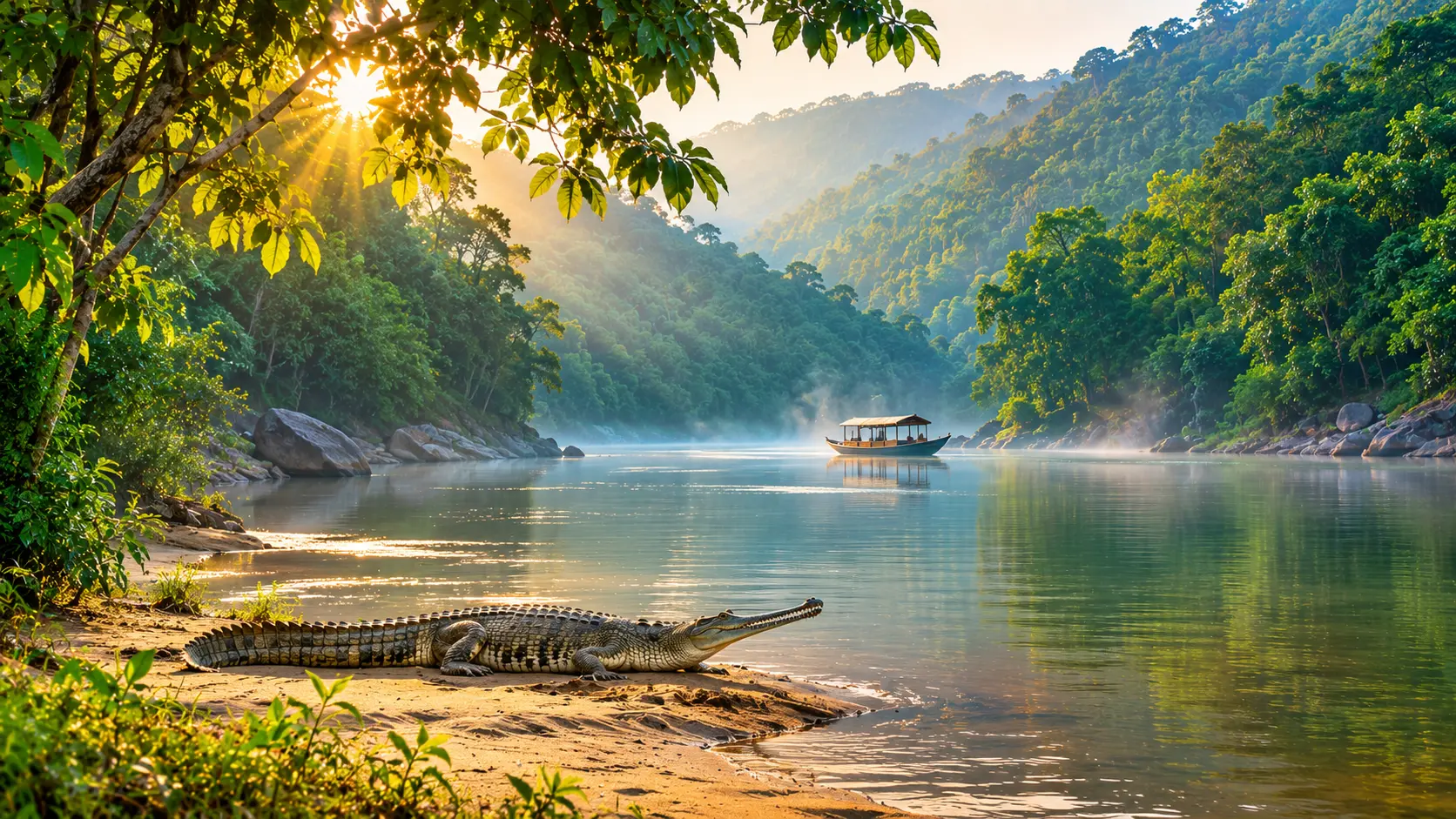
A Day on the Mahanadi: Where the River Squeezes Through the Hills at Satkosia
You leave Bhubaneswar in the dark.
The auto driver doesn’t talk, and you’re glad. The city is still asleep, the temple spires are black shapes against a sky just turning grey, and your bag holds two bottles of water, a hat you’ll forget to wear, and a phone at forty percent.
The road west wakes you up slowly. Flat fields first. Then a small river or two. Then the land begins to wrinkle, and the hills appear, low and green and a little blue at the edges, as if they aren’t sure they want to be seen.
Somewhere past the point where your signal drops to one bar, the driver slows for a goat. Then another goat. Then a whole family of goats, and a boy with a stick who stares at the car like it’s the strangest thing he’s seen all week. You wait. Nobody honks.
First lesson of the day: nothing out here moves at the speed of your plans.
The place
Satkosia is where the Mahanadi, one of eastern India’s great rivers, gets squeezed. For most of its life the river is wide and lazy. Here it has to cut through the Eastern Ghats, and the hills close in on both sides until the water runs through a gorge. The name is said to mean “seven kos”, an old measure of distance, the length of the gorge itself. Don’t hold me to the arithmetic. What matters is how it feels when you arrive.
You get there mid-morning, and it’s quiet in a way the city never is. No horns. No generators. Just wind in the trees and a low hum you can’t place until you see the water.
It’s wider than you expected, and slower. The colour is a dull green-brown, like tea left to sit. On the far bank the hills rise straight up, thick with forest.
The boat
The boat is narrow, wooden and has seen a lot of seasons. The boatman helps you in with one hand while he holds the rope with the other, and says almost nothing. He doesn’t need to. He pushes off, the engine coughs twice, then settles, and the bank starts to slide away.
Ten minutes in you stop checking your phone. There’s nothing to check. The gorge closes around you, and the sound of the engine bounces back off the rock so that it seems to come from three directions.
You sit very still, because your instinct says to.
The sanctuary around here is known for gharials, the long-snouted crocodilians that feed on fish and are among the most endangered large reptiles in the world. You’ve read about them. You know what to look for. You still aren’t ready.
The first one is just a log on a sandbar. Then the log blinks.
Long, thin jaws. A body that looks stitched from the same stone as the bank. It lies there in the sun with its mouth slightly open, so still that you hold your breath, as though breathing might make it leave. The boatman cuts the engine and lets the boat drift. Nobody speaks for a full minute.
Then it slides into the water without a ripple, and the river closes over it like nothing happened.
You grin like an idiot. You can’t help it.
The middle of the day
The sun climbs. The gorge turns hot and bright, and the water throws light back up under your hat. You drink half a bottle. The boatman drinks none and looks fine.
You spot a kingfisher on a dead branch, a flash of blue so bright it looks fake. Later a heron, standing in the shallows on one leg. Later still, on a rocky slope far above, something that might be a deer, or might be a trick of the light. You’ll argue about it for years.
A fisherman passes in a smaller boat, a net piled in the bottom. He raises two fingers off the oar in greeting. The boatman does the same. That’s the whole conversation.
At a wide bend, you land on a sandy bank for lunch. Rice, dal, a fried vegetable, something sharp and green you don’t recognise. You eat with your hands, sitting on a log, and it’s one of the best meals you’ve had in months. Hunger, heat and a river will do that.
The part nobody tells you
You expect the adventure to be the animals. It isn’t.
It’s the silence, mostly. It’s the slow shift of light on the rock face, from gold to white to a deep, tired orange. It’s realising, around three in the afternoon, that you haven’t thought about work, or money, or the message you were meant to answer. For about four hours you’ve just been a person on a boat.
There’s a stretch near the end where the gorge narrows so much you could almost throw a stone from one bank to the other. The engine goes quiet. The boatman points up, and you look: a ledge of rock, a tangle of roots hanging down, a single bird circling very high.
He says one word. “Dekho.” Look.
So you do.
Getting back
The return drive is the opposite of the morning. You’re tired in the good way, sunburnt on one arm, with sand in your shoes and a phone that’s finally found a signal and starts buzzing like an angry wasp. You ignore it for another ten minutes.
The goats are gone. The sky goes pink, then purple, then dark. The hills fade into the horizon until you can’t tell where they end and the night begins.
You think about the gharial. About how an animal that old, from a family that predates almost everything, is still down there in that brown water, going about its slow business, entirely unbothered by you.
It’s a good thought to fall asleep to.
If you go
Start early. The drive takes most of a morning from Bhubaneswar, and the light on the water is best before noon.
Check everything first. Boating, entry rules, permits and the best season change, so confirm with the Odisha forest and eco-tourism offices before you travel.
Carry water, a hat and sunscreen. There’s little shade on the river.
Stay quiet on the boat. The animals are the reason you came. Respect them and keep your distance.
Don’t leave rubbish. Carry it out.
This is a travel narrative, written to give a feel for the day. Details of the boat ride and the people are illustrative, so check current facts locally before you plan.
Writing from a quiet corner of Bhubaneswar near AIIMS, the Plorastay team keeps a guest house in Patrapada for travellers who plan trips like this. Free parking, free Wi-Fi, AC rooms and airport pickup.